
Researchers at the Massachusetts Institute of Technology (MIT) have developed a new liquid battery system that allows wind and solar plants to compete with convetional power plants.
The battery employs two electrodes, of which one is made of molten lithium and the other is a combination of lead and antimony, to store energy at a temperature over 200°C lower than earlier liquid metal designs.

Discover B2B Marketing That Performs
Combine business intelligence and editorial excellence to reach engaged professionals across 36 leading media platforms.
It has an operating efficiency of about 70%.
Earlier, the researchers have used magnesium and antimony layers to form the battery’s electrodes, which required an operating temperature of 700°C.
However, the latest battery version can operate at temperatures of 450 to 500°C
Antimony has been found providing a high operating voltage and lead gave a low melting point, while the combination of both the metals allowed the battery to operate at a lower temperature.
MIT John F. Elliott Professor of Materials Chemistry Donald Sadoway said: "We hoped [the characteristics of the two metals] would be nonlinear.
"They proved to be [nonlinear], but beyond our imagination. There was no decline in the voltage. That was a stunner for us."
The research has been backed by US Department of Energy’s Advanced Research Projects Agency-Energy and French energy firm Total.
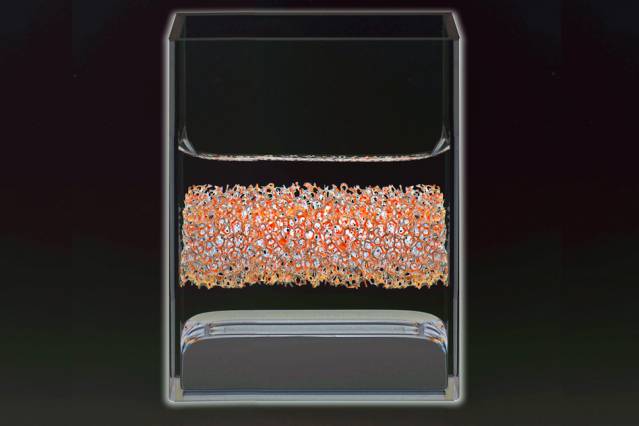
Sadoway, along with colleagues, has started a company to produce electrical-grid-scale liquid batteries, whose layers of molten material automatically separate due to their varying densities.
The research team plans to continue to identify other formulations that could offer even lower-temperature, less costs and higher-performance systems.
Sadoway said: "Now we understand that liquid metals bond in ways that we didn’t understand before."
After several testing, the researchers found that even after 10 years of charging and discharging on a daily basis, the system can retain about 85% of its original efficiency. This makes the technology an ideal investment for electric utilities.
Image: A physical model of the liquid metal battery at room temperature, in a glass container. Photo: Courtesy of Felice Frankel.


