
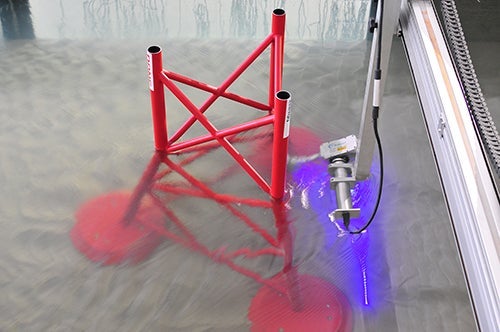
Dong Energy has teamed up with UK based independent research and consultancy in civil engineering HR Wallingford to develop next-generation of wind turbine foundations for offshore wind farms.
Under the project, the companies will develop a novel suction bucket foundation which will be more cost effective seabed foundation compared to ones used presently by the farms.

Discover B2B Marketing That Performs
Combine business intelligence and editorial excellence to reach engaged professionals across 36 leading media platforms.
The developers are currently looking alternative solutions to traditional monopile foundation which will not be cost effective but also competitive.
Dong Energy has taken help from HR Wallingford to design one such suction bucket foundation.
A part of the project, the researchers will study how these structures interact with, and impact the hydrodynamic conditions and the seabed.
The design is reportedly reliable in the laboratory and is likely to be adopted by developers, but prior to the mass adoption, the technology needs to be proven before its application for use in large-scale developments.
HR Wallingford technical director Professor Richard Whitehouse said: "The forces acting on offshore wind foundations will typically increase as water depth increases.
"For complex foundations, we currently use a combination of approaches to estimate likely scour, and this introduces a level of uncertainty in the design process.
"This research with DONG Energy will help us to develop greater certainty in the prediction of seabed response and design more efficient foundation solutions.
"Ultimately this will help to make offshore wind developments more costs effective, and developments in exposed locations and deeper waters more economically viable."
Image: Laser scanners measure the movement of sediment. Photo: courtesy of HR Wallingford.


